

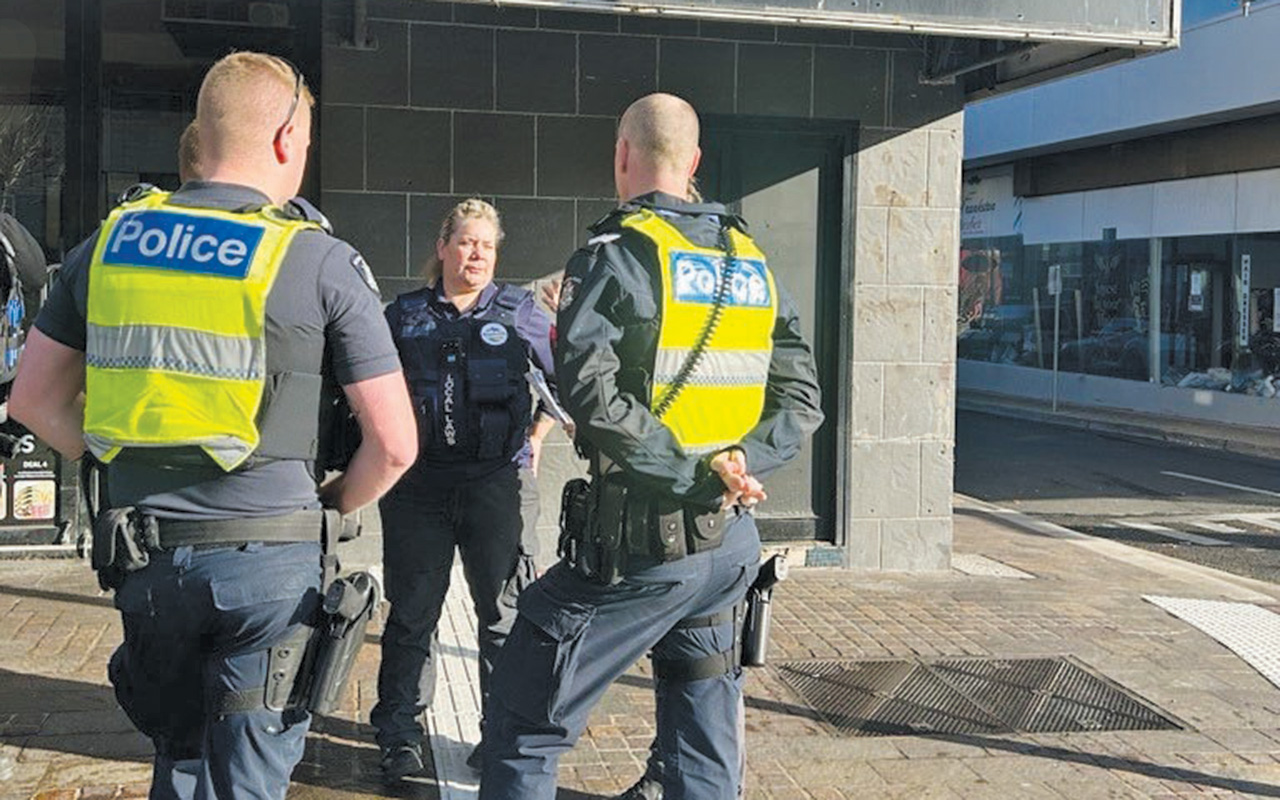
POLICE are exercising expanded powers to conduct weapon searches in Frankston’s CBD.
On 8 January, Victoria Police deputy commissioner Robert Hill declared all public places within Bayside Centre in Frankston as a “Designated Area under section 10D of the Control of Weapons Act 1990”. The declaration allows police to search a person for weapons without a warrant – police can conduct electronic wand searches, vehicle and bag searches, and frisks.
The published gazette reads that “a police officer may also exercise their power under the Act to direct a person to leave the designated area if they refuse to remove a face covering and the police officer reasonably believes they are wearing the face covering to conceal their identity or protect themselves from crowd control substances.
“A police officer may direct a person to leave the designated area if they reasonably believe that the person intends to engage in conduct that would constitute an affray or violent disorder. (…) It is an offence under the Act to obstruct or hinder a police officer or PSO in the exercise of a power to stop and search a person or vehicle or to fail to comply with a direction to leave the designated area without a reasonable excuse.”
The declaration came into effect at 8am on 12 January, and will expire at 11.59pm on 28 February. The “Designated Area” is bordered by Fletcher Road, Evelyn and Keys Streets, Park Lane and Wells Street, and Young Street.
Victoria Police has previously faced criticism for exercising its “designated area” powers. An extended designated area declaration made for Melbourne’s CBD late last year has been challenged in the Federal Court – Victoria Police revoked that declaration four months before its scheduled completion date last week.
When making the Frankston declaration last week, Victoria Police deputy commissioner Hill wrote “I am satisfied of the matters specified in sections 3A(3)(a)-(c) of the Victoria Police Act 2013 in making this declaration.” That section of the Act reads that “the declaration is necessary or desirable for community safety or reassurance of the public” and “is appropriate to assist police to provide a presence at the place or area specified in the declaration; or to deter crime or antisocial behaviour within the place or area specified in the declaration; or to provide reassurance for the safety of persons moving within, to or from the place or area specified in the declaration.
“The exercise of powers by protective services officers at the place or area specified in the declaration will not unduly limit the human rights of any person and in performing their functions and exercising their powers, protective services officers will be supervised by police officers,” the Act reads.
First published in the Frankston Times – 13 January 2026